

...there is not! This is of course strongly dependent on body size and pace! Nevertheless, an adjustment of the stride frequency can (positively) influence our performance when running.
We explain here how the stride frequency can be optimized while running and what stride frequency the fastest runners in the world come up with.
How is the stride rate determined?
The stride frequency indicates the number of steps per minute. In other words, how often the feet touch the ground in 60 seconds.
What is the average stride rate for running?
There are three main factors that significantly affect the stride rate when running:
- the running distance
- the running pace
- the body size or stature
With increasing running distance, a reduction of the running speed is to be expected anyway.
Other minor influencing factors are age and gender.
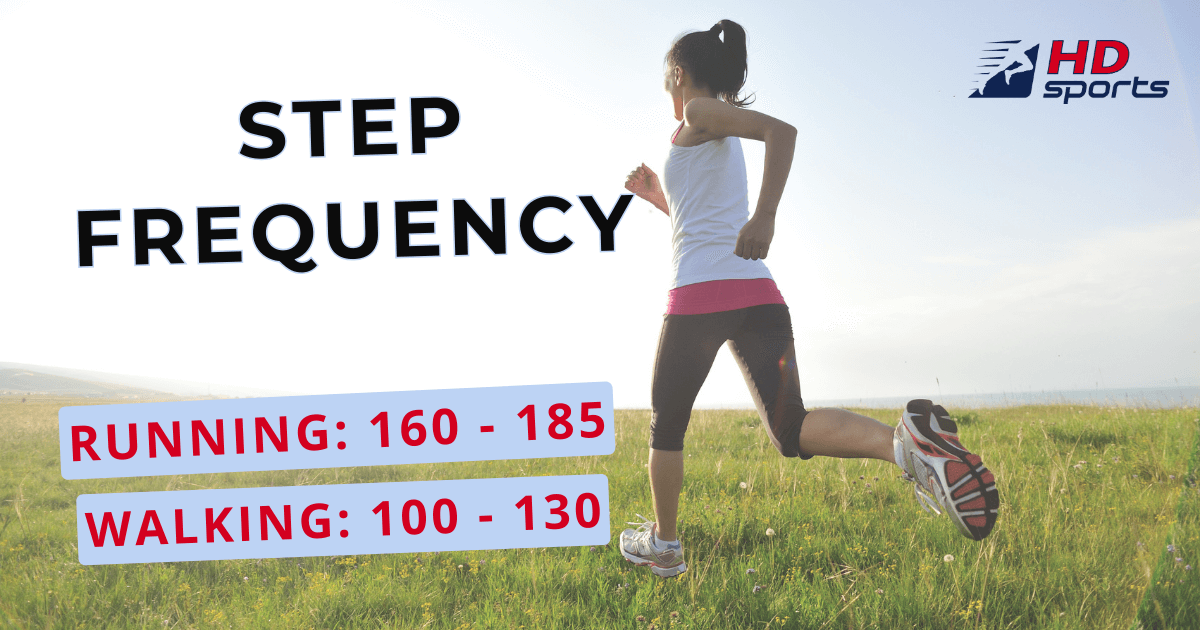
Generally, a cadence of 180 is recommended for running. However, this is not the "optimal" stride rate for every runner. A recommended range is about 160 - 185 steps per minute.
What is the stride rate of the world's fastest marathoners?
In a study of world-class marathon runners, a Finnish study found a surprising amount of variability. The stride frequency of marathon runners with a best time of under 2:08 hours was evaluated. The result: there were considerable differences between the top runners in the number of steps. A large proportion of the athletes achieved 156 to 187 steps per minute. That means the spread was about 20 percent and was therefore enormous. This says one thing above all else, that there is no such thing as an optimal number of steps per minute, even in elite sports. The study even found values of over 200 for individual athletes.
However, this is more or less the same as the "blanket value" of 180 steps, which is often spread as optimal. World-class marathon runners very often get into the 180 range. Since these athletes all ran at a similar pace, the factor that significantly affects stride frequency is body size or stature. A shorter runner logically achieves a higher stride rate, while a very tall runner averages a lower stride rate.
Among amateur runners, there are also other influencing factors, such as the running speed described above. So it is very likely that at low speed the stride frequency (and also the stride length) is somewhat lower.
How can the stride frequency be increased during running?
Increasing stride frequency is probably the wrong goal. Runners should better strive to "optimize" their stride rate.
If you want to run faster, you have two options. To increase the stride frequency or / and to increase the stride length. Usually it is a combination of both possibilities. No matter whether the length or the frequency is increased, the energy expenditure for it is naturally higher. However, there are differences and this can be tested in training. An abrupt increase in stride length requires a significantly higher energy expenditure. That's why the stride length of top runners decreases with increasing competition distance. An 800-meter runner, for example, achieves a significantly longer stride length than a marathon runner.
By increasing the stride frequency, there is a second possibility to increase the pace. This method is less strenuous, but still intense and is accompanied by an increase in heart rate.
Forms of training to increase stride rate are skipping: 10 seconds as often as possible with the feet touching the ground. A high priority in skipping is a short contact time of the feet with the ground. A technically clean execution is important.

Short, fast sprints with an exaggeratedly short stride frequency are also a good form of exercise. Best done during warm-up before an interval workout or tempo run.
Exercises to optimize the stride frequency?
If you basically have a good running feeling, you don't have to compulsively adjust your stride frequency.
From previous experience, some runners have the problem of a too low stride frequency in combination with a too long stride length. However, as we mentioned earlier, a long stride length is not very economical. This is especially true for amateur runners, who anyway do not have as well trained muscles as elite runners. The result in this case is not only inefficient running, but also the risk of injuries and overuse injuries.
It is best to observe the stride length yourself during your training. Many amateur runners don't even notice that they have an excessively long stride, which also makes it impossible to optimize the stride frequency. If the foot strike is made above the body's center of gravity, the stride length is too long. Excessive rolling over the heel can also be a sign that the stride length is too long. In this case, the stress on the feet and joints (especially the knees) is too high, or rather, "unnecessarily" too high.
Therefore our tip: Self-observation during training. If you have the impression that "possibly" the stride length is too long, you should try to minimally reduce the stride length and minimally increase the stride frequency in the following running sessions. At the beginning, this running style adjustment may seem unusual, but after a few sessions, the combination of shortening stride length and increasing stride rate could increase running performance while also reducing the risk of overuse.
How is the stride rate calculated when running?
- Count one minute while running. Or 20 seconds and multiply the value by 3.
- Almost all running watches without shoe sensors can roughly calculate the stride rate based on arm movements.
- Shoe sensors in the running shoe are even more accurate, although they are hardly ever used nowadays
Video analysis on the treadmill is not recommended because the running stride on the treadmill is not identical to the natural running style.
Comparison: stride frequency when walking and when running
The stride frequency when walking is approximately 100 - 130 steps. The slower the pace, the lower the stride frequency.
The stride rate for running is approximately 160 - 185 strides.
Step frequency calculator or table
Reliable or publicly known forms for calculating the ideal stride rate are almost none. This is mainly because there is not only a significant influencing factor with the body size. Because also the speed, the individual running style and the stature are factors that have a great influence on the ideal stride frequency.
Basically, the smaller the person, the greater the stride rate; the faster the pace, the greater the stride rate. For every cm of additional height, you can expect about half a step less per minute. A 160 cm runner gets about 15 steps more compared to a 190 cm runner at the same running pace.



Kommentar schreiben