
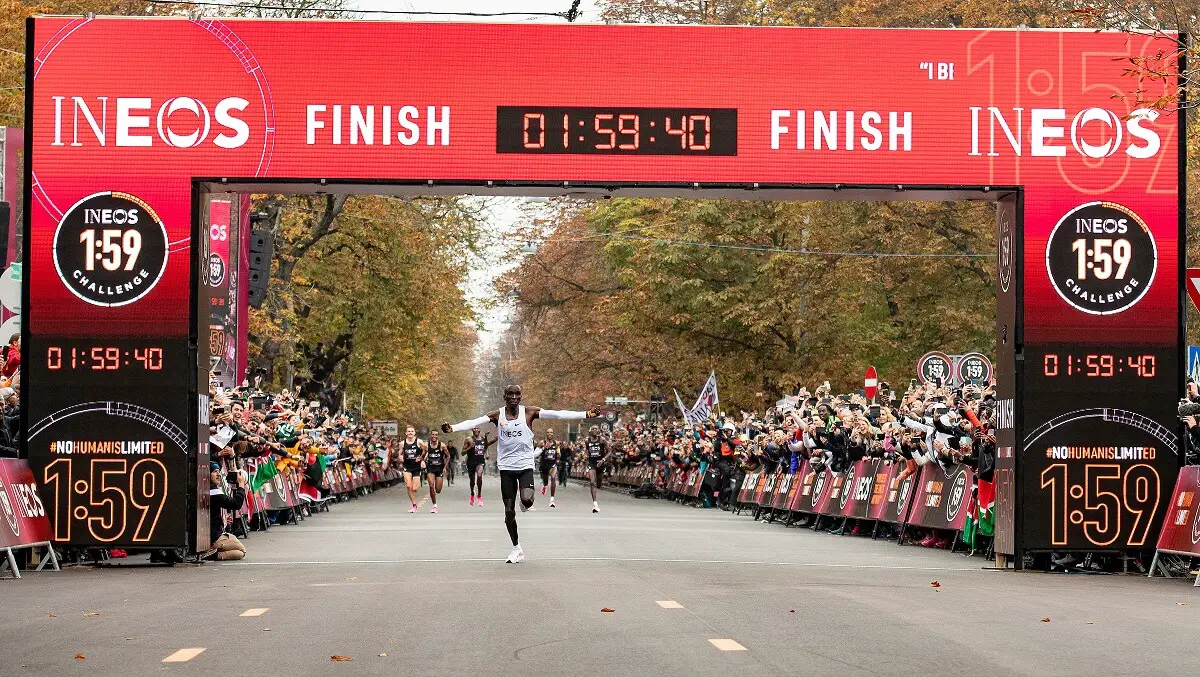
Eliud Kipchoge created a historic sporting event on October 12, 2019, that made headlines around the world.
He became the first human ever to run a marathon in under two hours. An athletic feat that not long ago was considered impossible.
The Evolution of the Marathon World Record
Almost 100 years ago, American Albert Michelsen achieved the first marathon time under 2:30 hours. In 1953, British runner Jim Peters ran the 42.195 kilometers in under 2:20 hours for the first time, and only 14 years later, Australian Derek Clayton ran under 2:10 hours, before African runners gradually took over dominance.
Berlin, Berlin…
In 2003, Paul Tergat started a series of world records in Berlin. He was the first human to run under 2:05 hours with 2:04:55. Five years later, Ethiopian Haile Gebreselassie achieved another milestone with 2:03:59. Yet this record stood only six years, until Dennis Kimetto from Kenya completed the marathon in 2:02:57.
Despite the successive improvements of the world record, at that time, few would have expected that just five years later the 2-hour mark would be broken. If someone had bet at a bookmaker on such an early date for this historic achievement, they would probably have become rich.
The Rise of Eliud Kipchoge
But in 2014, when Dennis Kimetto ran the first marathon under 2:03, Eliud Kipchoge was just at the beginning of a remarkable marathon career. The Kenyan had a personal best of 2:04:05 at the time. Extremely good, but still far from the 2-hour mark and more than a minute slower than the world record.
In the following years, Kipchoge went on an unstoppable rise: in 2015, he won the London and Berlin marathons, improving his best time in Germany to 2:04:00. In 2016, he defended his title in London with a new personal best of 2:03:05, before winning gold at the Rio Olympic Games. Now only the world record was missing.
…and then came Vienna
Kipchoge wanted more after Olympic gold. In 2017, he attempted the 2-hour mark at the "Breaking2" project in Monza. Under non-record-eligible conditions, he narrowly missed this historic feat with 2:00:25. However, he demonstrated to humanity that a sub-two-hour marathon was achievable in the near future.
After officially breaking the marathon world record in Berlin 2018 with 2:01:39, Kipchoge fully focused on a second attempt to run a marathon under two hours. And he succeeded! On October 12, 2019, at the INEOS 1:59 Challenge in Vienna, he ran 1:59:40 (2:50 per kilometer), becoming the first human in the world to run a marathon under two hours. A feat celebrated worldwide.
Eliud Kipchoge's Marathon Training
So how does a runner train to run a marathon under two hours? Essentially, Kipchoge’s training plan is less complex than one might expect. Of course, many other factors play a crucial role in athletic success. Nike produced specially designed shoes for the record attempt, which can make the critical difference between finishing slightly under or over two hours. Other significant factors include the training environment and altitude in Kenya’s highlands over 2,000 meters. Talent also plays a major role. However, only with structured and targeted training can a marathon under two hours become reality.
No Experiments in Training
Kipchoge focuses on consistency in his training and minimizes experiments. He generally never trains two consecutive days at high intensity, giving his body the necessary time to recover and process the workload.
Two Core Sessions: Interval Training and Long Tempo Runs
Tuesday, Thursday, and Saturday are planned for intense sessions. On Tuesday, he performs interval training on the track, running up to 15 kilometers at marathon pace (e.g., 15 x 1,000 meters with 90 seconds rest) or 8 to 15 kilometers at half-marathon pace or faster (e.g., 20 x 400 meters in 65 seconds with 50 seconds rest). Key Feature: The pace increases progressively. For 1,000-meter intervals, he starts at 2:55 to 3:00 per kilometer, finishing the last intervals at 2:42 – 2:45 per kilometer. In good form, even faster.
Thursday is reserved for the long tempo run: a core marathon session. Unlike advice for recreational runners, the "long run" is not done as slow as possible. Kipchoge runs 30–40 kilometers at 20–25 seconds above marathon pace. The first two kilometers are easy, then he holds the planned pace. These runs are often over hilly terrain, with flat sections still close to marathon pace.
Extremely Important: Fartlek
Another key session in Kipchoge’s marathon training is the fartlek on Saturday, mostly on trails or partially flat sections. He alternates between high speed (marathon pace or slightly faster) and easy running. Typical fartlek sessions are 30 times one minute fast + one minute easy or 5 times ten minutes fast + two minutes easy.

Many Easy Runs
On Monday, Wednesday, and Friday, Kipchoge runs two easy runs: a morning moderate run of 16–21 kilometers, and an afternoon easy run of 8–12 kilometers. On Sunday, he completes another moderate run of around 20 kilometers.
In summary, a typical training week for Eliud Kipchoge preparing for a marathon:
Monday
- Moderate run (16–21 km)
- Easy run (8–12 km)
Tuesday
- Interval training on track
Wednesday
- Moderate run (16–21 km)
- Easy run (8–12 km)
Thursday
- Long tempo run (30–40 km), mostly on hilly terrain
Friday
- Moderate run (16–21 km)
- Easy run (8–12 km)
Saturday
- Fartlek, mostly on trails
- Easy run or rest
Sunday
- Moderate run (18–22 km)
All of Kipchoge’s training takes place above 2,000 meters altitude. He also places high importance on regular strength training.



Kommentar schreiben